

Bolometer
Your clip through a thermal camera, for Resolume
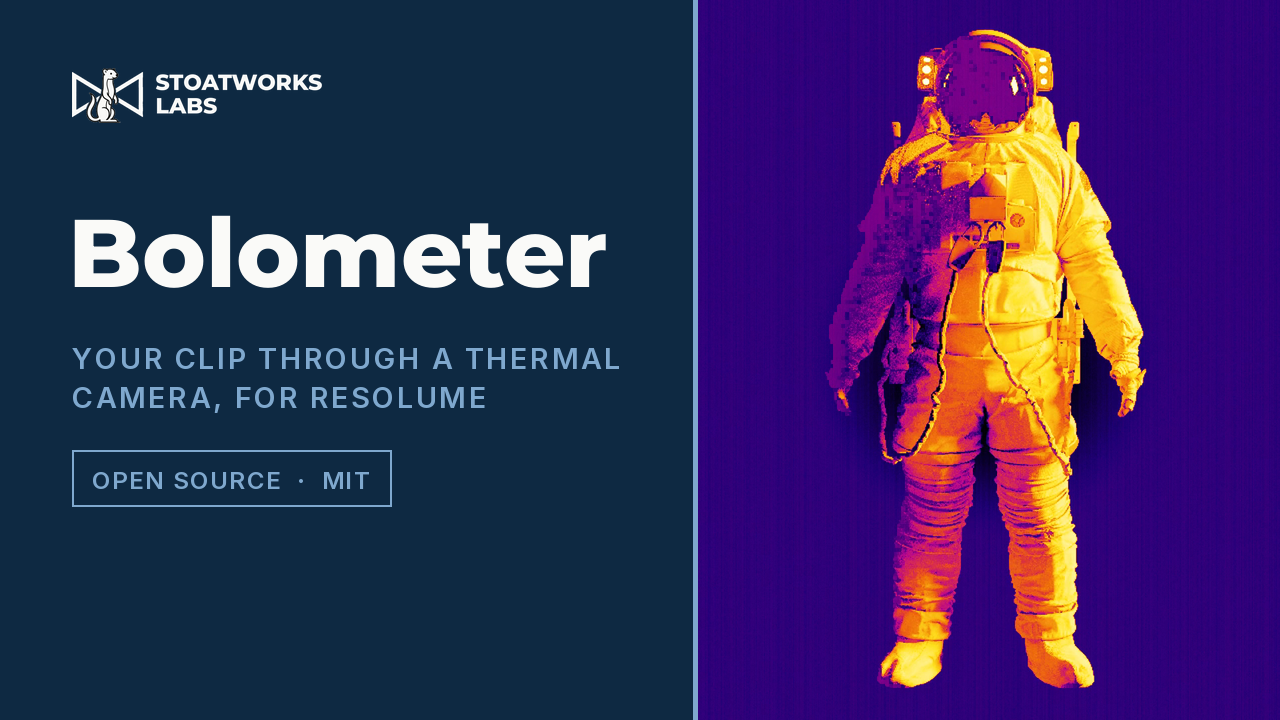
What it does
One FFGL effect for Resolume Arena and Avenue: SW Bolometer shows your clip the way a small thermal camera would, the kind built on an uncooled microbolometer core, with the clip's brightness standing in for temperature (15 °C for black, 40 °C for white).
Nothing is drawn on top. Every pixel is a bolometer, a tiny thermal mass that warms towards what it sees with a 12 ms time constant, so a fast-moving bright thing leaves a short warm smear. The picture is read out at 9 Hz, the frame rate below which export rules leave a thermal camera uncontrolled, and held between readouts, so it moves in a stutter; 30 and 60 Hz are there too.
Every 30 seconds (or when you press Shutter) the camera closes its shutter for a flat-field correction: the picture freezes for most of a second, then comes back clean. Between shutters the sensor drifts, and grain and column stripes creep in; a dark narcissus spot, the sensor seeing its own reflection, sits dead centre and no shutter removes it.
The picture is made the way the cores make theirs: plateau equalisation shares the palette out among the temperatures in view, so when something hot comes in the rest of the scene drops in contrast, damped over a few frames; detail enhancement rings hot edges with dark halos; and the result goes through White Hot, Black Hot, Ironbow or Rainbow.
- A thermal camera's picture of your clip: brightness read as temperature, 15–40 °C
- Bolometers with a 12 ms thermal time constant, read out at 9, 30 or 60 Hz and held between readouts
- Flat-field corrections that freeze the picture on a timer or when you press Shutter
- Drift, grain and column stripes that grow between shutters, and a narcissus spot no shutter removes
- Plateau equalisation with damping, or a manual Level and Width
- Detail enhancement's dark halos, and four palettes: White Hot, Black Hot, Ironbow and Rainbow
- Universal macOS bundle and Windows x64 DLL
Where it stands
v0.1.0, and early days. In Resolume Arena 7.29.0 on a Mac it loads with every control as declared and, over a still test card, the drift grows on Arena's clock, a Shutter press wipes it and every control a still can show changes the picture. On Windows it loads, registers and renders in Resolume Arena 7.27.1 on software rendering (no GPU), with every control as declared and Arena's log clean, and every control the automated check could judge on a still changed the picture. Neither has been through a show. Everything else is measured offline, by a harness driving the real plugin on a Mac: each pixel's lag follows its equation to 1.5e-12 K and reads back as 12.00000 ms at every frame rate tried, nearly two million host frames read out exactly the sensor instants integer arithmetic gives, the shutter freezes exactly the frames it should, and the automatic gain's histogram matches an independent count to the last sample. It catches thirty-seven models broken on purpose and twenty-seven one-character sabotages of its own code. It has never been compared with a real thermal camera: how brightness becomes temperature, how fast the drift grows and the narcissus spot's size are chosen, not measured, and frame noise, the optics' blur and the sensor's low resolution are left out. On a dark clip with small flickering lights the automatic gain can turn the flicker into flashing, more so at 60 Hz or in Rainbow; the defaults stayed within photosensitivity guidance over Resolume's demo clips, and the guide says how to keep a show there. There's a user guide and a browser demo, but no presets. Try it in your own rig before you trust it in a show.
Watch it running
Nothing loads from YouTube until you press play.Watch it there instead