

Mynah
Type the cue, don't hunt for it
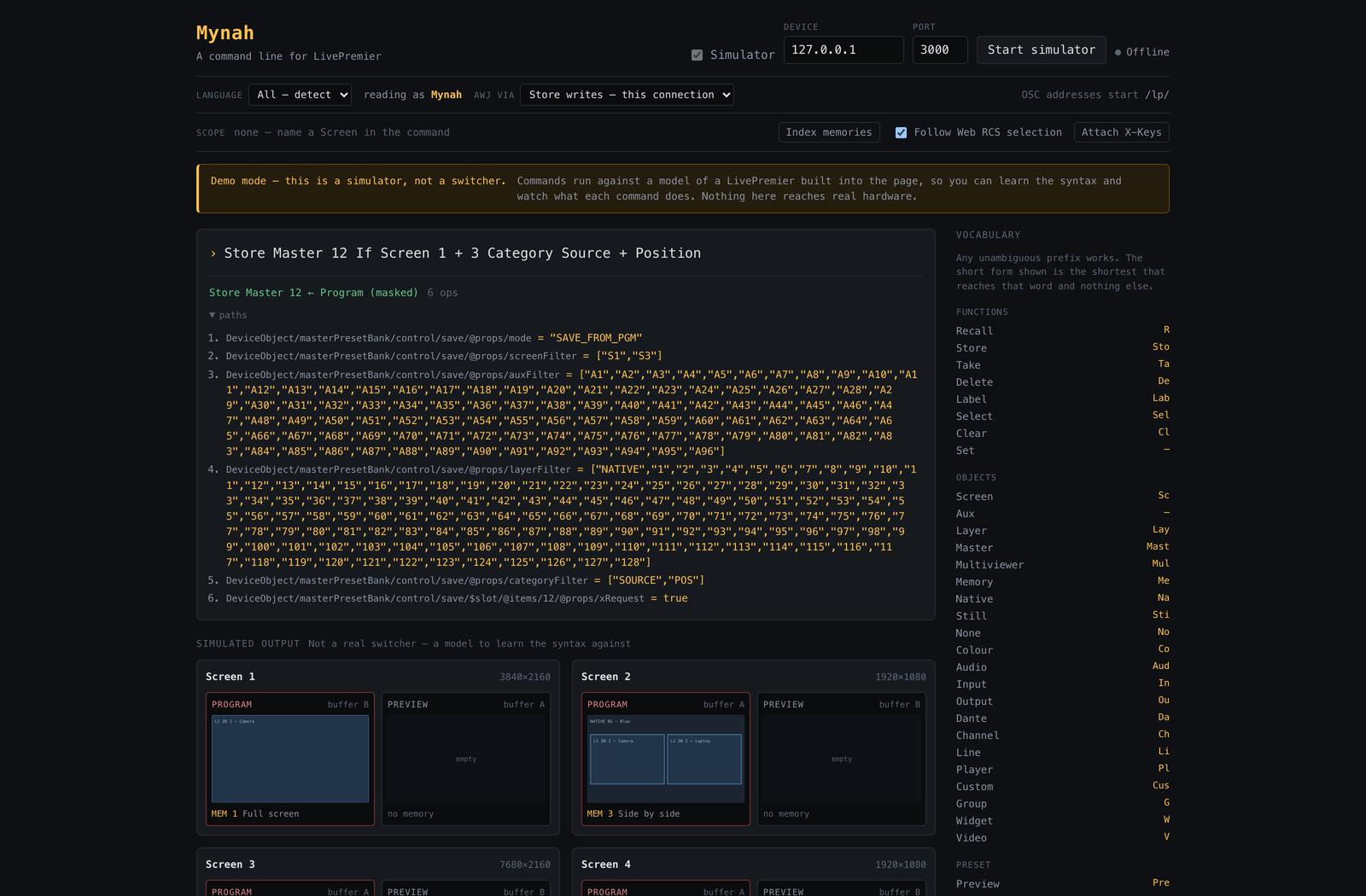
What it does
A LivePremier holds a thousand screen memories, five hundred master memories and fifty layer memories, and the stock interface reaches them all by pointing. Anyone who has operated a lighting desk knows the alternative: say what you want in one line, without your eyes leaving the screen.
Mynah borrows grandMA3's grammar rules — verb first, any unambiguous abbreviation, Thru/+/- ranges, and an If clause that masks a store — and keeps the switcher's own vocabulary throughout. “Recall Screen 1 Thru 4 Memory 7” is four screens in one line; “R Sc 1 Th 4 Me 7” is the same command.
It is careful about the truth: an unqualified recall goes to preview, never to air, and a recall of an empty memory is reported as empty rather than as success — the device accepts those silently and does nothing.
Since 1.4.0 the language core compiles for a second platform: pass it MIDRA and the same sentence spells itself for a Midra 4K or Alta 4K — takes under the transition tree, screen, aux and master banks, UP/DOWN preset buffers resolved from the device's state — and refuses, before sending, what that platform does not have. The web app and Stream Deck plugin still assume LivePremier; LivePremier Plus embeds the core and offers the Console on both.
The same grammar drives a keyboard, an X-Keys panel, a Stream Deck plugin and a Bitfocus Companion module whose preset library fills a deck with memory recalls.
One caveat before you try the hosted copy: a LivePremier serves its control interface over plain http with 443 closed, and browsers refuse an insecure connection from a secure page. So the hosted copy runs a simulated LivePremier instead — four screens, the four memory banks, and the device's own awkward behaviour reproduced on purpose. To drive a real switcher, use the desktop app, the container, or a local checkout on the same network.
- grandMA3's grammar rules with the switcher's own vocabulary — verb first, any unambiguous abbreviation, Thru/+/- ranges, and an If clause that masks a store
- Screen, master, layer and multiviewer memories — recall, store, label and delete — plus Take, live layer control in pixels or percentages, and audio routing
- Every command's device paths shown before anything is sent, and a command that cannot work refused while you are typing it, with the reason
- An unqualified recall goes to preview, never to air, and an empty memory is reported as empty rather than as success
- A second platform in the language core since 1.4.0 — Midra 4K and Alta 4K spelled for their own object model, refusing what that platform lacks before sending
- A desktop app for macOS, Windows and Linux, a container image and a hosted demo that is honest about being one — a page served over HTTPS cannot open a connection to a switcher
- A built-in LivePremier simulator to learn against, and command history
- The same grammar on an X-Keys panel over WebHID, a Stream Deck plugin and a Bitfocus Companion module
- AWJ, raw store JSON and OSC accepted at the command line, for the cases the grammar does not cover
Where it stands
Released at v1.5.0. It has driven a real switcher: every verb in the grammar was executed against a physical Aquilon C on firmware 6.2.73 — store, recall, label, delete, a layer memory, a program recall, a Take and the six-op masked master store — with the filters read back exactly as compiled, and on 9 September 2026 every path the grammar emits, the audio matrix included, was issued at a second Aquilon C and answered. The Midra 4K and Alta 4K spellings added in 1.4.0 were written on both simulators and read back, then proven on a live Pulse 4K on 12 and 13 September through LivePremier Plus, which embeds this core: 35 of 35 lines compiled for that platform answered on the box, and the operator typed Recall, Store … Preview and Delete at its Console — this grammar's first writes to Midra hardware. 1.4.0 also fixed a real bug: the master save mode is SAVE_FROM_PRW, not SAVE_FROM_PVW, on both platforms, and the device had been refusing the wrong spelling in silence, so every Store Master … Preview had stored from program. 1.5.0's audio routing on Midra 4K and Alta 4K was written on the simulators and read back; the object model and enums came off the live Pulse 4K. Neither the X-Keys nor the Stream Deck path has ever been run against real hardware, and the web app and the Stream Deck plugin still assume LivePremier — only the language core knows the second platform. Not affiliated with Analog Way.