

Bubble
A draining soap film, for Resolume
What it does
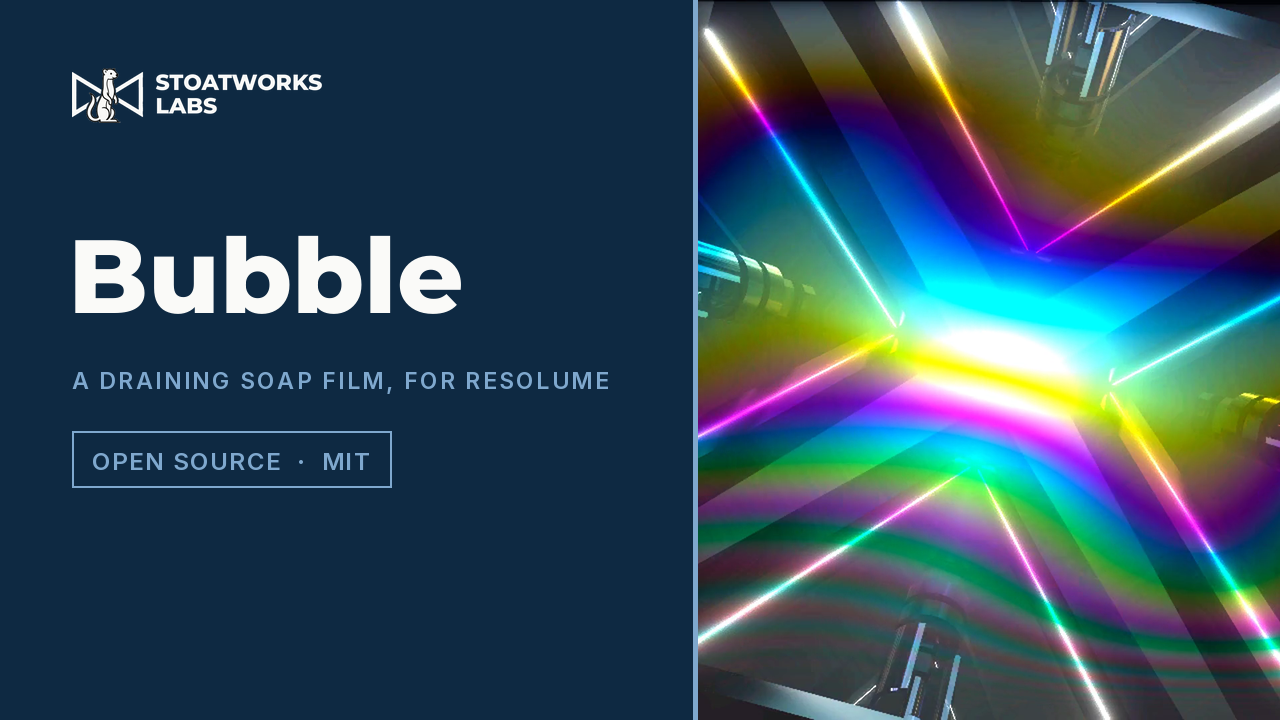
An FFGL effect for Resolume Arena and Avenue, SW Bubble: your clip reflected in a draining soap film. Set the new film's thickness, from 0.2 to 4 micrometres, how fast it drains, how hard it's stirred and whether its black film is common or Newton black; choose how far the black film comes down before it bursts, slow the burst down up to a thousand times, and set how long the frame stays empty before a new film is pulled. Pop bursts it now, and New Film pulls a fresh one.
The colour comes from the thickness. Light reflected from the film's front face and its back face interferes, so the plugin sums the reflections of a film of water for every wavelength from 360 to 830 nm, weighted by the CIE's colour-matching functions under daylight, and tints your clip with the result. The thickness follows the drainage law Monier and colleagues measured for soap films in 2024: the film keeps one shape and thins fastest at the top, so bands of colour slide down and spread, the top goes silvery white and then, below 30 nm, black with a sharp edge. A chosen stirring carries pieces of film about, and each keeps thinning as it moves.
It bursts as soap films do: a hole opens in the black film and its rim runs out at the Taylor–Culick speed, faster through thin film than thick, a few thousandths of a second in real life and as slow as you like here. It costs about 0.6 ms of GPU time a frame at 1080p on an Apple Silicon Mac with the film still, and 1.3 ms stirred. Some settings flash, a fast Pop or a film set to burst as soon as it's made: the user guide says which.
- Thin-film colour from water's two faces, summed over the CIE colour-matching functions, not a drawn gradient
- Drainage by Monier et al.'s self-similar law: colour bands sliding down to a sharp black film
- Common or Newton black film
- A chosen six-eddy stirring that carries the film's thickness with it
- A burst at the Taylor–Culick speed, with slow motion up to 1000 ×, a refill time, Pop and New Film
- The viewing angle, and an exposure set on Resolume's own demo clips
- Universal macOS bundle and a Windows x64 DLL
Where it stands
v0.1.0, and early days. It's measured by an offline harness driving the plugin's own code on an Apple Silicon Mac, at two rasters and on Apple's software renderer, reading the picture back: a film's colour matches the harness's own sum of the physics to within two thirds of a tolerance built from the colour table's own bound, the black film's edge sits on the row the drainage law predicts in every column, the film is identical to the bit at 24, 60 and 144 fps, and the burst's hole is the predicted disc to the pixel. It catches twenty-two models that are wrong on purpose and sixty-five one-character sabotages of its own code, and all 12 controls change the picture. In Resolume Arena 7.29.0 on a Mac every control was there with its default and changed the picture, Thickness at once; Pop and New Film pressed through Arena's API did what they say, and a new film at the defaults burst 30.3 s in on Arena's clock, as the drainage law says, with a new film two seconds later; a clip retrigger doesn't pull a new film. On Windows, in Arena 7.27.1 with no GPU, it loaded with every control as declared and every control the automated check could set changed the picture. Both were over still pictures: no moving clip and no show yet. It has never been compared with a real soap film. The stirring is chosen rather than computed from the film's own flow, and every default but Exposure is a choice. Some settings flash (Burst at 0 with a near-zero Refill, Pop pressed fast with a short Refill, and the defaults on a clip that already flickers): the user guide says which. Open questions the guide lists: a thinner or faster default film, Exposure clipping the brightest clips, a transparent rather than black backdrop, a curved bubble mode, the stirring's speed bound, and the frame waiting out a burst's whole span before Refill starts. The CIE colour tables it ships are under CC BY-SA 4.0, the code MIT. The macOS build is Developer ID-signed and notarised. There's a user guide and a browser demo, but no presets. Try it in your own rig before you trust it in a show.
Watch it running
Nothing loads from YouTube until you press play.Watch it there instead